SAS4A/SASSYS-1 Reactor Dynamics and Safety Analysis Code
The SAS4A/SASSYS-1 (SAS) computer code is developed and maintained by Argonne National Laboratory for thermal, hydraulic, and neutronic analysis of power and flow transients in liquid-metal-cooled nuclear reactors (LMRs). With its origin as SAS1A in the late 1960s, the SAS series of codes has been under continuous use and development for decades and represents a critical investment in advanced reactor safety analysis capabilities for the U.S. DOE.
SAS4A was developed to analyze accidents with coolant boiling and fuel melting and relocation initiated by a very low probability combined with failure of one or more safety systems. SASSYS1, originally developed to address loss-of-decay-heat-removal accidents, has evolved into a tool for margin assessment in design basis accident (DBA) analysis and for consequence assessment in beyond-design-basis accident (BDBA) analysis. Although SAS4A and SASSYS1 are generally portrayed as two computer codes, they have always shared a common code architecture, the same data management strategy, and the same core channel representation. Subsequently, the two code branches were merged into a single code referred to as SAS4A/SASSYS-1.
SAS4A/SASSYS-1 has been coupled to a variety of analysis and optimization tools, such as Star-CCM+, Dakota, RAVEN, SAM (the System Analysis Module under development as part of the U.S. DOE NEAMS program), and PDC (the Argonne Plant Dynamics Code that models S-CO2 Brayton cycles). Several benchmark models have been developed for validation of whole-plant passive safety response based on EBR-II tests conducted in the 1980s. Two of these tests, Shutdown Heat Removal Tests 17 and 45R, are the basis of an IAEA CRP led by Argonne. Additional benchmarking of the SAS code has been performed using experimental data from FFTF, the Phénix reactor and the NACIE-UP facility, although this list is not exhaustive of the benchmarking and validation basis of the code.
The code is currently supported on intel-based macOS, Windows, and Linux platforms. Source code is compliant with Fortran 90/95 free-formatted source and can be compiled with any standards-compliant Fortran compiler.
The latest code manual is available online. Details on the latest code updates can be found on the SAS4A/SASSYS-1 public wiki.
Obtaining a License
To obtain a license for SAS4A/SASSYS-1, prospective users need to contact Argonne’s Technology Development and Commercialization Division. Licenses may be obtained for executable only or for full source code access. Once a fully executed license has been approved, the code manager handles distribution to the licensee. To determine which type of license is appropriate for you, we recommend contacting the SAS development team.
A version of SAS4A/SASSYS-1 with a reduced feature-set, MiniSAS, is freely available for academic and non-commercial use. MiniSAS is built from the same source as SAS4A/SASSYS-1, but excludes fuel relocation and steam plant models. It is also limited to five core channels, which is adequate for most analyses. Licenses for MiniSAS (executable copies only) are also available for non-commercial use under a general license agreement.
Capabilities
- Single-pin channel models for rapid evaluation of transients
- Detailed thermal-hydraulic sub-channel models for subassembly pin bundles
- Support for three-dimensional visualization of sub-channel temperatures
- Support for liquid-metal coolants such as sodium, NaK, lead and LBE, as well as other single-phase coolants
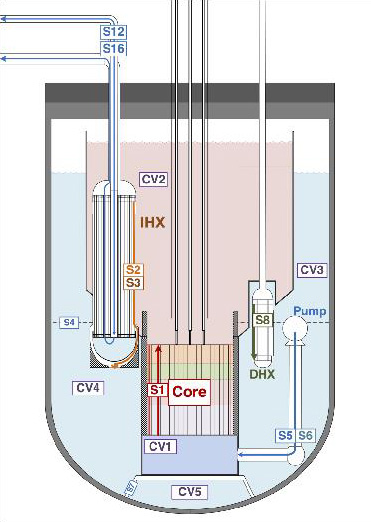
- Full-plant coolant system models to simulate passive heat removal and natural shutdown
- Fuel models for fuel melting, in-pin motion, pin failure, and ex-pin fuel dispersal and freezing
- Fuel pin characterization and transient models for metallic and oxide fuel pins.
- Reactor point kinetics with comprehensive treatment of reactivity feedback effects as per first-order perturbation theory
- High-fidelity decay heat models
- Built-in support for ANS standard decay heat properties
- Built-in support for alternative coolants in decay heat removal loops
- Support for coupling to third-party computational fluid dynamics tools (such as STAR-CCM+) for representing thermal stratification in large volumes
- Support for coupling to third-party computational tools (such as GOTHIC) for representing ex-vessel cooling
- Detailed reactor and plant control systems
Development History
Development of the SAS family of computer codes began in the mid‑1960s to model the early stages of accidents in sodium‑cooled fast reactors. The first version, SAS1A, grew out of sodium‑boiling studies and incorporated key physics such as coolant flow (single‑ and two‑phase), fuel and cladding heating and deformation, molten fuel motion, and reactor kinetics with reactivity feedback. By 1974, these capabilities matured into SAS2A, which added improved boiling models and strengthened analysis of loss‑of‑flow (LOF) and transient‑overpower (TOP) events up to cladding failure and fuel/cladding melting.
Later versions expanded the code’s mechanistic detail and its applications. SAS3A introduced models for fuel and cladding melting and relocation and was used extensively in safety analyses supporting licensing of the Fast Flux Test Facility. To address evolving licensing needs (including the Clinch River Breeder Reactor Plant), SAS4A added new models for fuel‑pin deformation, disruption, and material relocation and was validated against TREAT M‑Series experiments.
In parallel, a closely related variant—SASSYS‑1—was created to model the entire plant coolant system outside the reactor, enabling simulations of accident sequences driven by loss of heat removal and other system‑level events. Because SAS4A and SASSYS‑1 shared the same underlying architecture and core representation, they were ultimately merged and are now distributed as SAS4A/SASSYS‑1. Version 2 was shared internationally in the late 1980s and became a common tool supporting oxide‑fuel model development.
From the mid‑1980s through the Integral Fast Reactor (IFR) program (1984–1994), development continued with increased emphasis on metallic fuel and on accident prevention through inherent (passive) safety behavior. This work culminated in Version 3.0 (1994) and included new metallic‑fuel models as well as expanded whole‑plant transient analysis capabilities—particularly for EBR‑II, the IFR prototype—where plant dynamics are essential for predicting passive safety feedback.
After the 1990s, SAS4A/SASSYS‑1 continued to evolve through maintenance and capability upgrades to meet U.S. DOE program needs. Version 3.1 was completed as a major maintenance update in the mid‑1990s and later released in 2012. Since 2012, the software has been supported by various DOE program and is currently being maintained by DOE’s Fast Reactor Program (FRP). A summary of the latest code releases is maintained on the SAS4A/SASSYS-1 public wiki.
Protected Loss of Flow Transient Simulation
Tests carried out by Argonne were used to perform validation for advanced safety simulations, such as the one shown here from SAS4A/SASSYS-1. This image shows the calculated fuel, cladding, coolant, and structure temperatures for the XX09 experimental assembly and its six neighbors during a full-power loss of flow accident.