Nuclear Science and Engineering
Simplified Radionuclide Transport Source Term Analysis Code
SRTTool for Sodium Reactor and Microreactor Radionuclide Transport and Retention Analysis
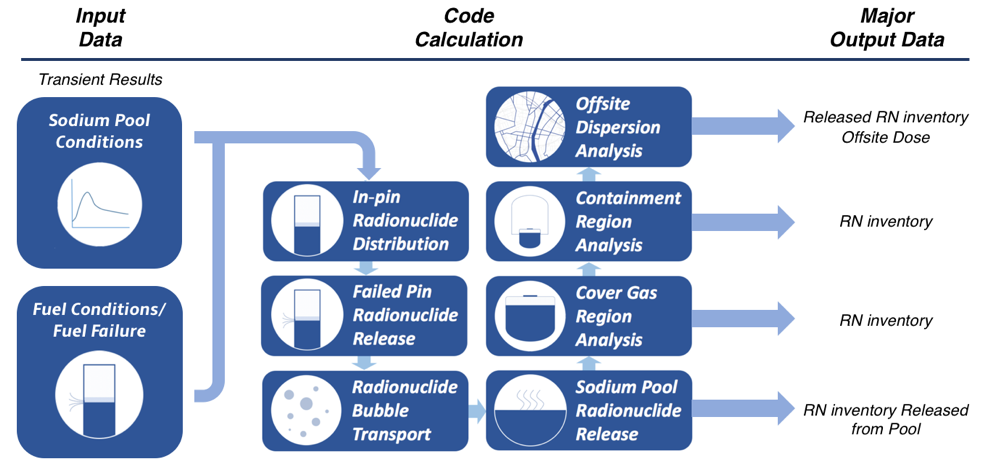
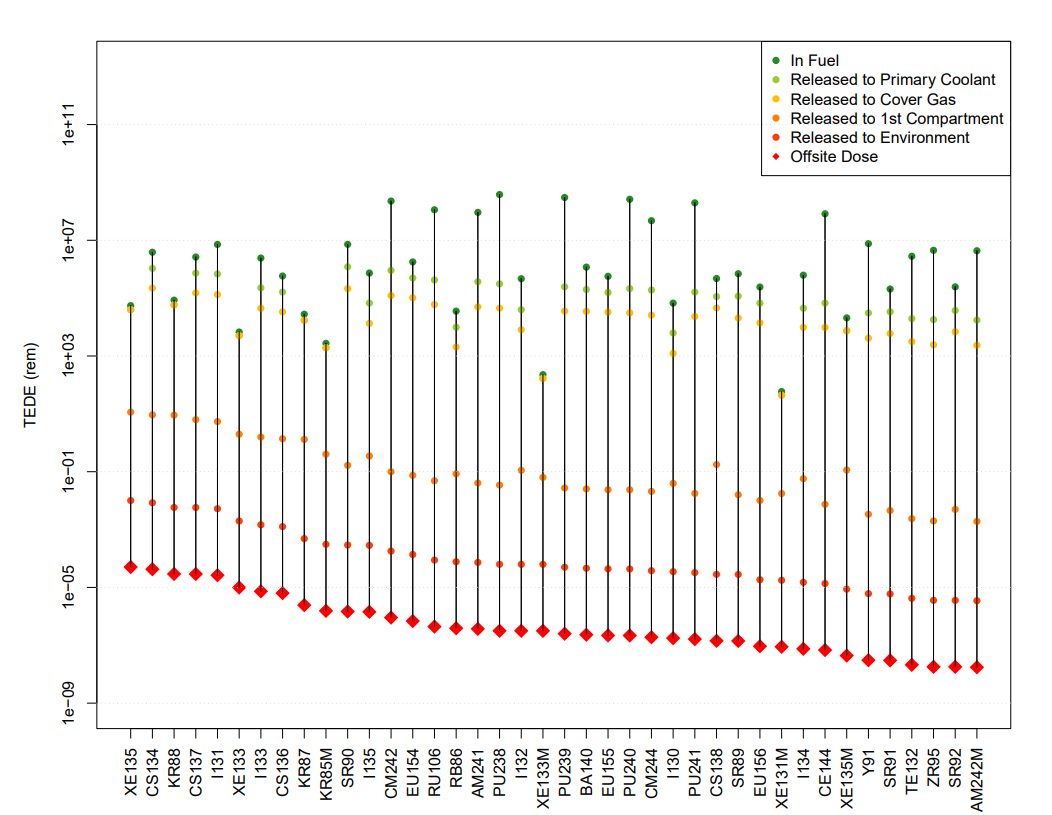
SRT is a computational tool developed by Argonne National Laboratory for rapid mechanistic source term analyses for pool-type, metal fuel SFR designs and metal fuel microreactor designs. SRT provides time-dependent radionuclide inventories throughout the reactor system and building, along with offsite dispersion and dose results using Gaussian plume models. The code is designed to facilitate uncertainty and sensitivity analyses for the determination of factors and phenomena influential in the transport and retention of radionuclides.
Features
- Highly-customizable models through user input
- Uncertainty/sensitivity parameters within user input
- Models for multiple radionuclide transport/retention phenomena:
- In-pin radionuclide migration
- Release from failed fuel
- Bubble transport through the sodium pool
- Vaporization from the sodium pool
- Radionuclide behavior in the cover gas region or inert reactor vessel
- Radionuclide behavior in the reactor building compartments
- Offsite dispersion calculation
- Customizable reactor building compartments
- Radionuclide release from ex-core sources
- Detailed graphical and text outputs
How to obtain the code
SRT is available for licensing. Please contact SRThelp@anl.gov for further information.
Recent Publications
- T. Starkus, D. Grabaskas, D. H. Kam, Shayan Shahbazi, “The Development of Simplified Radionuclide Transport Code (SRT) Version 2.1,” in Proceedings of the Advance Reactor Safety conference, Las Vegas, NV, 2024.
- T. Starkus, D. H. Kam, S. Shahbazi, D. Grabaskas, M. Bucknor, “The Release of the Simplified Radionuclide Transport (SRT) Code Version 2.1,” ANL/NSE-24/3, 2024.