

2D IR Spectrometer
- Ultrafast 2D IR spectrometer designed for use in transmission for bulk systems and attenuated total internal reflection.
- Allows measurements of solvation dynamics, orientational diffusion of molecules in solution, and vibrational coupling and anharmonicity.
- Specifically designed to allow measurement of difficult, highly scattering samples and solid-liquid interfaces.


Advanced Photon Source
- The Advanced Photon Source (APS) at Argonne enables researchers to conduct in-situ, high-energy X-ray scattering and pair distribution function analysis of nanopore-confined catalysts.
- The AMEWS team is developing X-ray scattering techniques that exploit APS as a unique high-energy X-ray light source to decipher atomic scale structure for pore-confined interfacial water remediation catalysts under functional (operando) electrochemical conditions.
- This work combines with AMEWS synthesis and modeling approaches to tackle fundamental questions of how confinement and interfacial chemistries can be controlled to create interfacial chemical reactivity for water remediation chemistry.

Array of “Bubblers” Containing Chemical Precursors Used in Atomic Layer Deposition
- Atomic layer deposition (ALD) is a highly controlled method for depositing precise thin films to a desired thickness onto a substrate.
- ALD enables the “growth” of differing multilayer structures.


Atomic Layer Deposition Reactor (Beneq Model TFS 500)
- Enables users to deposit simple binary oxides, metals, and complex nanocomposites in a well-controlled manner.
- Capable of depositing large 300mm wafers/objects.

Atomic Layer Deposition Tool Equipped with In-Situ Infrared Spectroscopy
- Atomic layer deposition tool equipped with stop valve enables long chemical exposures required for sequential infiltration synthesis (SIS).
- Supplies a wide variety of chemical precursors into small working volume for efficient precursor utilization.
- In situ infrared spectroscopy offers chemical insight into polymer, precursor, adduct, and byproduct formation during SIS processing.

Cypher-ES Atomic Force Microscope (AFM)
- High-resolution atomic force microscope capable of C-AFM, EFM, KPFM, MFM and PFM modes and imaging in liquid cell (with bluedrive add-on for imaging in liquids with reduced noise).

Drop Shape Analyzer (DSA25)
- Designed for determining the wettability of solids my means of the contact angle as well as the surface tension of liquids.
- Quick and versatile dosing for surface-free energy and surface tension.
- High-resolution camera and high-quality zoom lens for accurate display of the drop with optimum size lead to a precisely measured contact angle or surface tension.


Ellipsometer with a Liquid Cell
- In-situ ellipsometry for understanding SIS kinetics and watching ALD growth.
- Ex-situ, variable-angle ellipsometry for deconvoluting the polymer and inorganic components of SIS composites.
- Equipped with a humidity controller to perform ellipsometric porosimetery, which can reveal pore size and volume of newly synthesized porous membranes.
- Equipped with a liquid sample cell that can be used to measure polymer brush thickness and density in a variety of aqueous environments (in collaboration with T1).


Focused-Ion-Beam Scanning Electron Microscope
- FIB-SEM is used to produce 2D and 3D images of surface topography and is able to resolve nm-scale features.
- AMEWS researchers use auto slice-and-view software to obtain the 3D structure of materials.

Gas Chromatography-Mass Spectrometry (GC-MS)
- Characterization tool that enables the separation and quantification of gases, as well as volatile and semi-volatile organic compounds based on their mass-to-charge ratio.
- The retention times of specific compounds are determined by their interactions with the GC column (SH-Q-BOND, 30 m × 0.32 mm × 10 μm). This setup utilizes a Shimadzu GCMS-QP2020 NX single quadrupole mass spectrometer, which is equipped with a headspace autosampler but also supports both gas and liquid sample injections.

Inductively Coupled Plasma Mass Spectrometry for In-Situ Electrochemical Dissolution Studies
- Reveals the dynamics of surface atom removal and consequent changes to surface morphology.
- Coupling to a stationary probe rotating disk electrode allows for quantitative dissolution rate measurement at pg.cm-2.s-1 levels for almost any element in the periodic table.
- System suitable for measuring single crystal surfaces, thin films, nanoparticles, as well as surface-bound molecular catalysts.

Isothermal Titration Microcalorimetry (ITC)
- Isothermal titration microcalorimetry (ITC) measures the binding affinity and thermodynamics of molecular interactions. The technique is based on the measurement of heat evolved or absorbed when complexes are formed between molecules.
- It has the advantage of determining all binding parameters in a single label-free, in-solution experiment, including binding affinity (KD), reaction stoichiometry (N), enthalpy (ΔH), and entropy (ΔS). These thermodynamic data provide insight into the forces that drive complex formation, enabling function and mechanism to be described at a molecular level.
- PEAQ-ITC is designed for ease-of-use and exceptional sensitivity. It has many advantages, including high signal-to-noise ratio, fast response (8 seconds), high sensitivity enabling low sample loading amount, measuring a broad affinity range from sub-millimolar to picomolar dissociation constants (10-2 to 10-12 M) using direct or competitive binding techniques, flexibility in buffer and temperature selection (10 °C to 80 °C), and highly automated process (sample injection, measurement, washing, and data analysis) with high reproducibility and easy operation.

QSense Analyzer
- Four-channel QCM-D system that provides high-quality data with low drift from four temperature-controlled channels in parallel.
- Measures multiple harmonics to:
- Enable quantification of changes in mass or viscoelastic properties of soft layers.
- Distinguish changes in layer thickness from changes in viscoelastic properties.
- The tool is a good fit for testing and comparing different samples at the same time. In addition to the high throughput, it delivers trustworthy results in a broad range of measurement conditions and can be complemented with accessory modules to expand the capabilities even further.
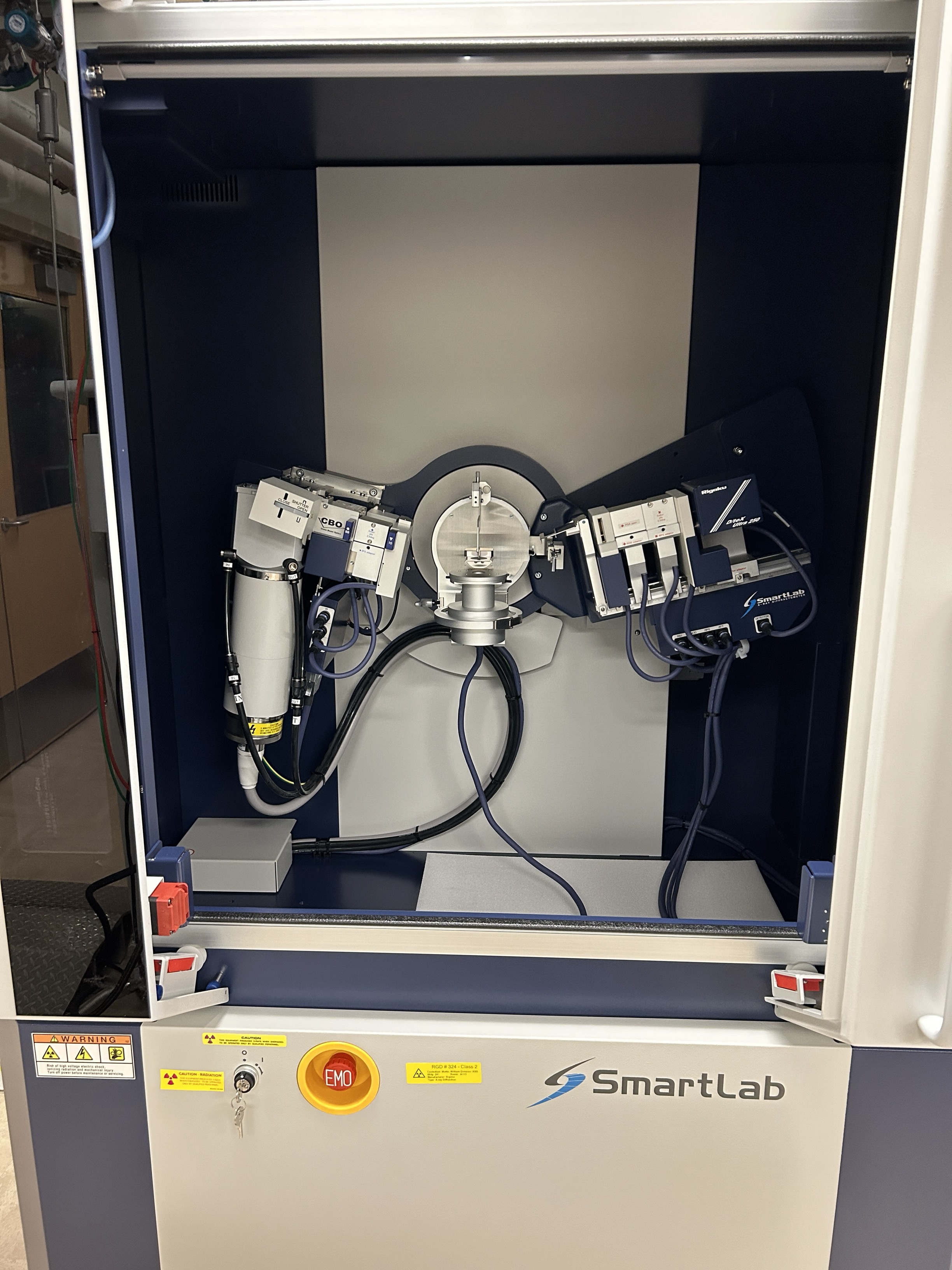
Rigaku SmartLab SE X-ray Diffractometer
- Multi-purpose X-ray diffractometer with built-in intelligent guidance.
- Offers ease-of-use features, including automatic alignment, component recognition, cross-beam optics, a multi-sample plate, and advanced-photon-counting hybrid pixel array detectors.

SRS QCM200 Quartz Crystal Microbalance
- Quartz crystal microbalance with dissipative monitoring combines real-time adsorption and desorption measurements in a liquid-phase environment. The QCM is sensitive to sub-monolayer mass changes and can measure viscosity and mechanical properties of adsorbed materials.
- The technique is used by AMEWS researchers to monitor both the synthesis and adsorption-desorption characteristics of model surfaces. The technique yields chemisorption rates of functional molecules and corresponding activation energies, which are then used in comparison with simulations and theory.
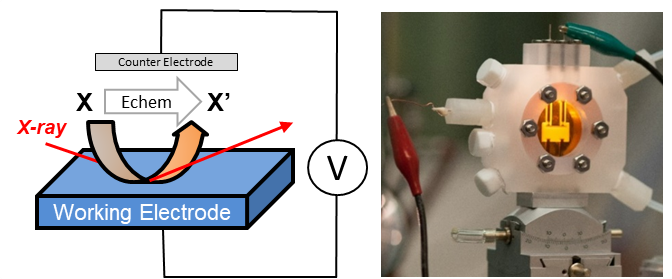
X-ray Reflectivity (XR) for Operando Observations of Water-Electrode Electrochemical Interactions
- XR probes the interfacial structure (including the vertical fluid distributions and electrode structure).
- Coupling with resonant reflectivity probes element-specific distributions as well as sensitivity to oxidation state.
- Measurements at hard X-ray synchrotron facilities (e.g., Advanced Photon Source) enables rapid measurement of interfacial evolution.