Argonne National Laboratory
EV Consumer Interest and Satisfaction
Consumer interest and satisfaction levels in electric vehicles are high.
Ownership Interest and Experience
- Over 80% of BEV owners who are shopping for a new car say they are likely to buy an electric vehicle (EV), according to the J.D. Power U.S. Electric Vehicle Experience (EVX) Ownership Study.
- 64% of new car shoppers that do not already own an EV are somewhat / very likely to consider an EV for their next purchase or lease, according to J.D. Power.
EV Affordability

Electric vehicle costs are attractive thanks to fuel savings, tax credits, and other benefits.
EVs Reach Cost Parity with Gasoline Vehicles
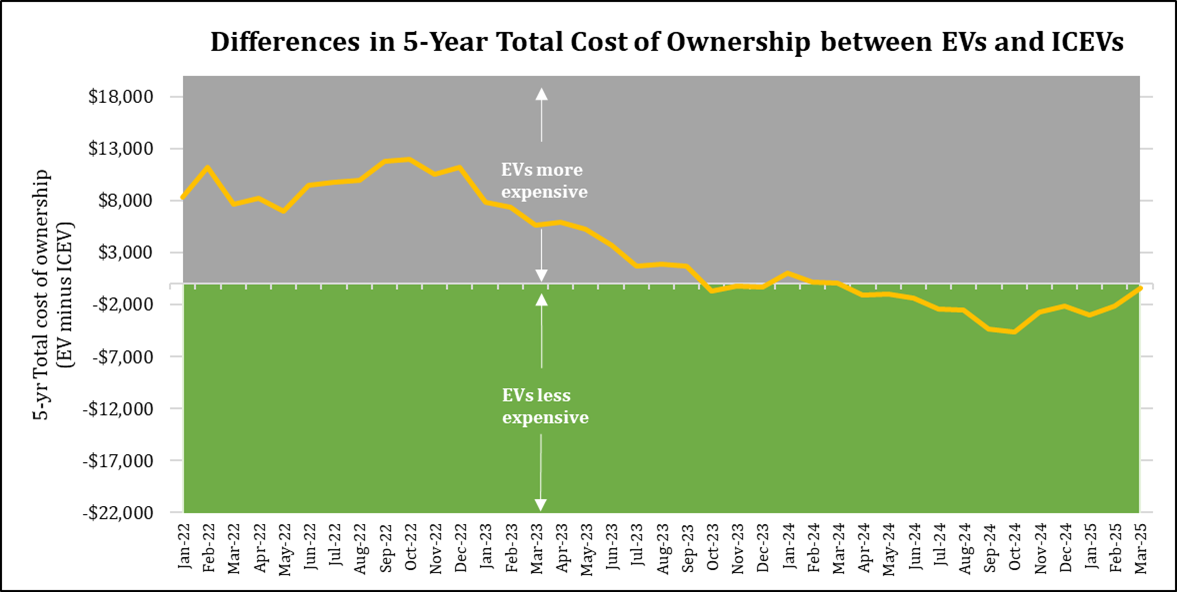
Including incentives, EVs have reached price-parity with comparable ICE counterparts according to J.D. Power.
Fuel and Operation Savings
- EVs are less expensive to own and operate than conventional vehicles.
- Families that drive an EV can save up to $2,000 in fuel costs annually and $6,000 over the life of the vehicle in lower maintenance and repair cost.
- The U.S. Department of Energy’s (DOE) Argonne National Laboratory’s Driving Electric: Local Fuel Savings Calculator enables drivers to estimate, at the ZIP code level, how much they would save on fuel costs by driving a PHEV or BEV.
Battery Life
New electric vehicles come with a battery warranty that protects the buyer for at least 8 years or 100,000 miles.
- EV batteries last at least as long as traditional gasoline vehicle equivalents, such as engines and transmissions.
- EV batteries are federally mandated to last at least 8 years or 100,000 miles, which far exceeds the average mass market transmission warranties (typically 5 years, 60,000 miles).
- Research from the U.S. Department of Energy’s National Renewable Energy Laboratory shows current EV batteries will last 12 to 15 years and between 100,000 and 200,000 miles and improvements continue to be made.