
No, QuantEM isn’t a typo. It’s the name of a new tool designed to automatically spot and handle errors in quantum programs.
Quantum computers are incredibly powerful — but also incredibly sensitive. Even small disturbances can throw off a calculation. While full error correction is the ideal solution, it currently requires a lot of extra work and resources. A lighter-weight alternative, called quantum error detection (QED), simply checks whether an error has occurred and discards the result if it has. The catch? Adding these detection steps by hand is complicated and easy to get wrong.
To make this process easier, researchers from the U.S. Department of Energy’s Argonne National Laboratory and several universities created QuantEM, a modular compiler that automatically integrates QED codes into quantum programs.
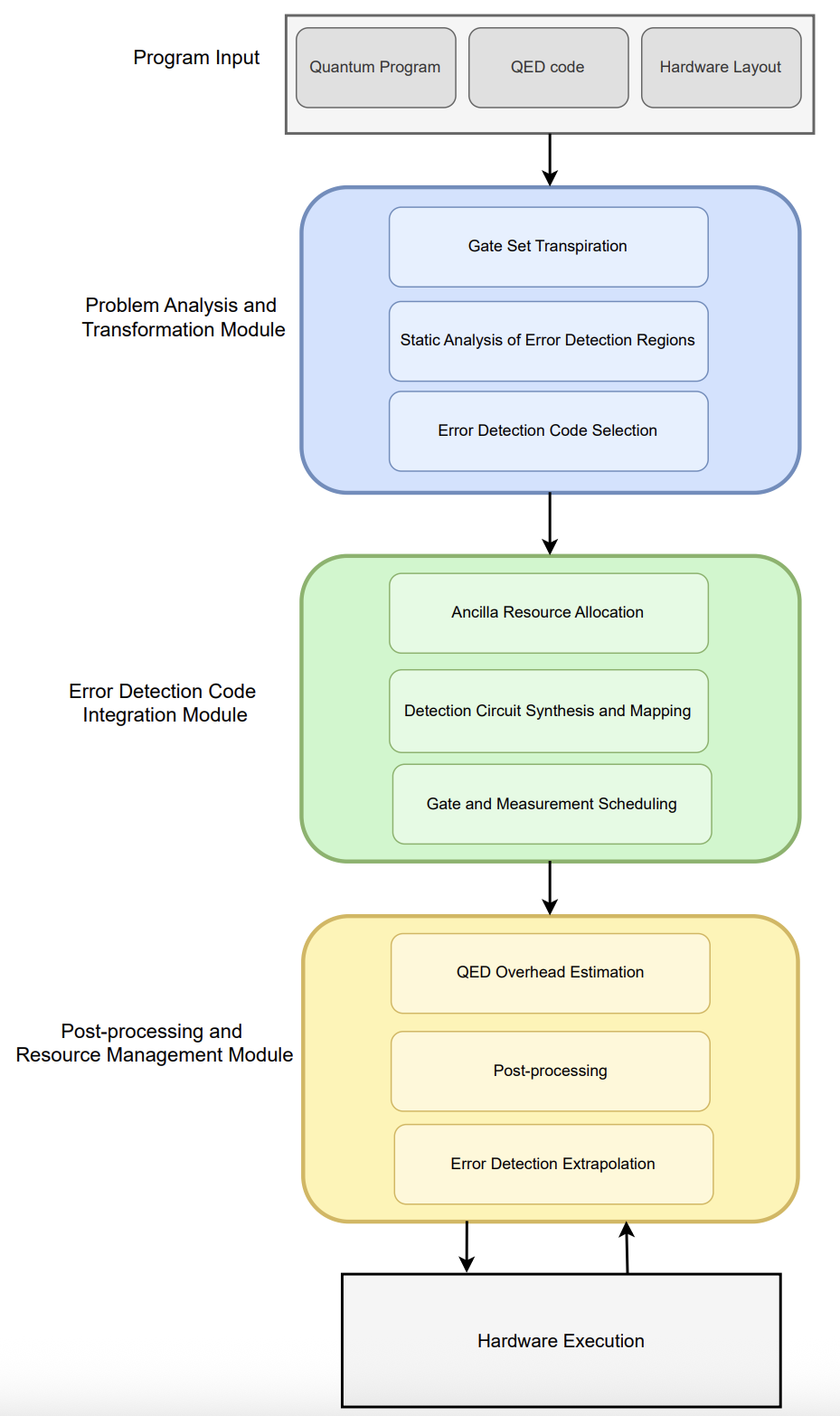
QuantEM consists of three modules:
-
Program analysis and transformation module — figures out which error-detection approach best fits the circuit.
-
Error detection code integration module — adds the needed qubits, maps the circuit onto the chosen hardware and schedules operations efficiently.
-
Postprocessing and resource management module — balances how accurate the detection needs to be with the extra hardware and the time it requires.
In short, the user gives QuantEM a high-level quantum circuit, an error detection method and a target hardware, and it produces an optimized version ready to run (see Figure 1).
“A key feature of QuantEM is that users can select codes and hardware targets from the compiler’s library or they can let QuantEM automatically choose based on the program’s structure and estimated resources,” said Ji Liu, an assistant computer scientist in Argonne’s Mathematics and Computer Science (MCS) division and first author of the paper reporting the research.
Because QuantEM is modular, users can experiment with different ways of inserting error checks and can scale up error detection for larger applications. The research team demonstrated these benefits in two examples: embedding parity checks in a 4-qubit circuit and inserting logical qubits in a noisier 6-qubit system.
“By automating the complicated steps needed for QED, QuantEM makes it easier for users to try out different ideas,” said Alvin Gonzales, a postdoctoral appointee in Argonne’s MCS division and a coauthor of the paper. “It also ensures that the detection logic is applied correctly across different hardware.”
The researchers emphasized that QuantEM is designed to be flexible. Each stage of the compiler can be customized or extended to support future QED schemes and hardware targets.
“As new architectures and methods become available, we plan to update QuantEM to keep pace,” Liu said.
For more details, see Ji Liu, Quinn Langfitt, Mingyoung Jessica Jeng, Alvin Gonzales, Noble Agyeman-Bobie, Kaiya Jones, Siddharth Vijaymurugan, Daniel Dilley, Zain H. Saleem, Nikos Hardavellas, and Kaitlin N. Smith, “QuantEM: The quantum error management compiler,” https://arxiv.org/pdf/2509.15505
Argonne National Laboratory seeks solutions to pressing national problems in science and technology by conducting leading-edge basic and applied research in virtually every scientific discipline. Argonne is managed by UChicago Argonne, LLC for the U.S. Department of Energy’s Office of Science.
The U.S. Department of Energy’s Office of Science is the single largest supporter of basic research in the physical sciences in the United States and is working to address some of the most pressing challenges of our time. For more information, visit https://energy.gov/science.