Argonne traces its birth from a secret mission — the Manhattan Project — to create the world’s first self-sustaining nuclear reaction. Today, the laboratory’s initial charge to find peacetime uses for atomic energy has broadly expanded, as researchers seek to find new discoveries that will advance American prosperity and security.
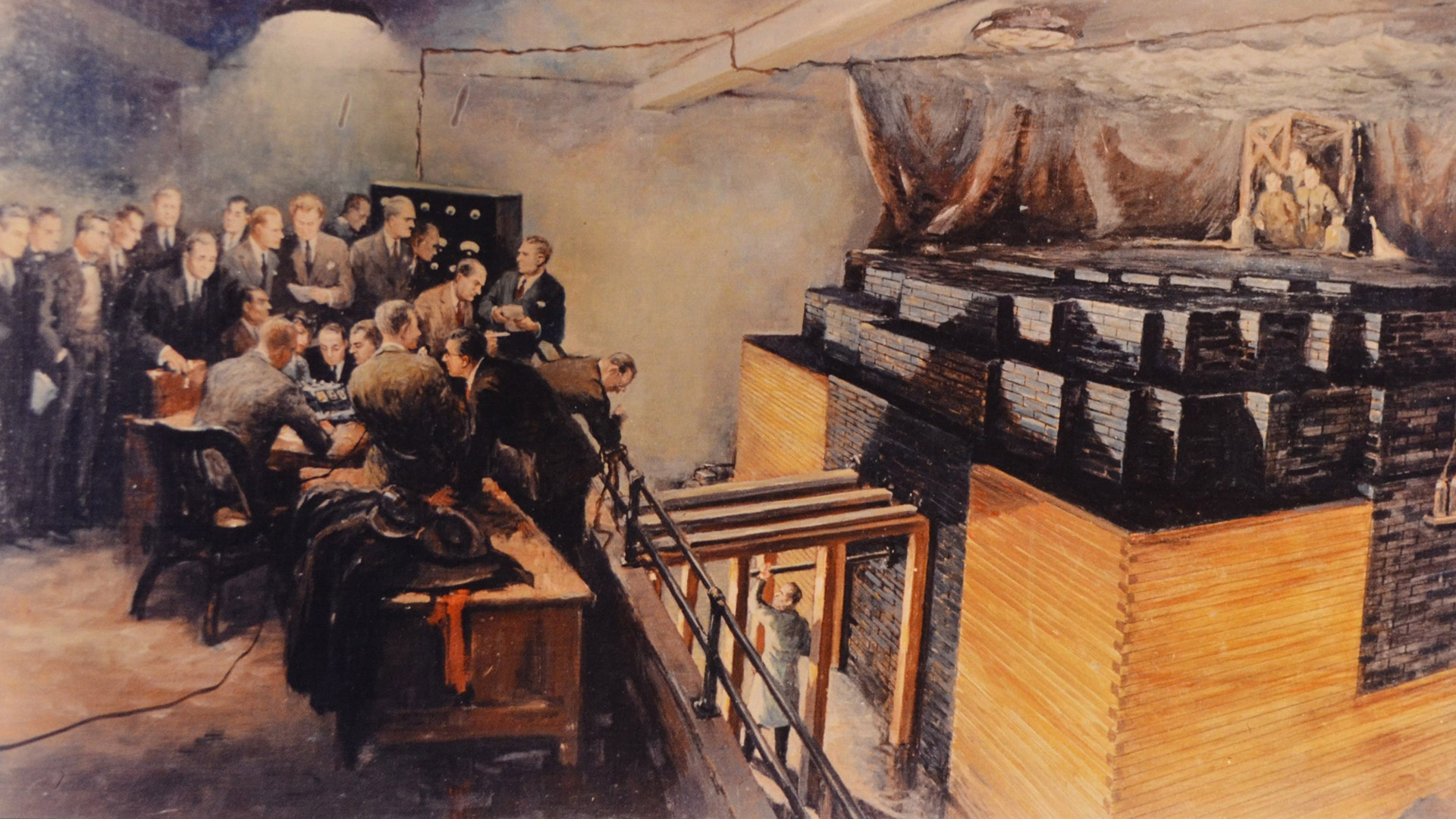
In its embryonic state as the “Metallurgical Lab,” the team of physicists who would give rise to Argonne constructed Chicago Pile-1, which achieved criticality on December 2, 1942, underneath the University of Chicago’s Stagg football field stands. Chicago Pile-1 was the site of the world’s first controlled, self-sustaining nuclear reaction. Because the experiments were deemed too dangerous to conduct in a major city, the operations were moved to a spot in nearby Palos Hills and renamed “Argonne” after the surrounding forest.
On July 1, 1946, the laboratory was formally chartered as Argonne National Laboratory to conduct “cooperative research in nucleonics,” making it the country’s first national laboratory. At the request of the U.S. Atomic Energy Commission — later known as the U.S. Department of Energy — Argonne began developing nuclear reactors for the nation’s peaceful nuclear energy program. In the late 1940s and early 1950s, the laboratory moved to a larger location in Lemont, Illinois, and established a remote location in Idaho, called “Argonne-West,” to conduct further nuclear research.
In quick succession, the laboratory designed and built Chicago Pile 3, the world’s first heavy-water moderated reactor, and the Experimental Breeder Reactor I, built in Idaho, which lit a string of four light bulbs to produce the world’s first nuclear-generated electricity in 1951. Knowledge gained from the Argonne experiments formed the foundation for the designs of most of the commercial reactors currently used throughout the world for electric power generation, and continue to inform designs of liquid-metal reactors for future commercial power stations.
Conducting classified research, the laboratory was heavily secured; all employees and visitors needed badges to pass a checkpoint, many of the buildings were classified, and the laboratory itself was fenced and guarded. Such alluring secrecy drew visitors both authorized — including King Leopold III of Belgium and Queen Frederica of Greece — and unauthorized. Shortly past 1 a.m. on February 6, 1951, Argonne guards discovered reporter Paul Harvey near the 10-foot (3.0 m) perimeter fence, his coat tangled in the barbed wire. Searching his car, guards found a previously prepared four-page broadcast detailing the saga of his unauthorized entrance into a classified “hot zone.” He was brought before a federal grand jury on charges of conspiracy to obtain information on national security and transmit it to the public, but was not indicted.
Not all nuclear technology went into developing reactors, however. While designing a scanner for reactor fuel elements in 1957, Argonne physicist William Nelson Beck put his own arm inside the scanner and obtained one of the first ultrasound images of the human body. Remote manipulators designed to handle radioactive materials laid the groundwork for more complex machines used to clean up contaminated areas, sealed laboratories or caves. In 1964, the “Janus” reactor opened to study the effects of neutron radiation on biological life, providing research for guidelines on safe exposure levels for workers at power plants, laboratories and hospitals. Scientists at Argonne pioneered a technique to analyze the moon’s surface using alpha radiation, which launched aboard the Surveyor 5 in 1967 and later analyzed lunar samples from the Apollo 11 mission.
In addition to nuclear work, the laboratory maintained and greatly expanded a strong presence in the basic research of physics and chemistry. In 1955, Argonne chemists co-discovered the elements einsteinium and fermium, elements 99 and 100 in the periodic table. In 1962, laboratory chemists produced the first compound of the inert noble gas xenon, opening up a new field of chemical bonding research. In 1963, they discovered the hydrated electron, which is a free electron in a solution and the smallest possible anion.
That same year, Argonne researcher Maria Goeppert Mayer was awarded the Nobel Prize in Physics for discovering the nuclear shell model. This discovery gave scientists some of the deepest insights into the character of the nucleus and charted a new course for nuclear physics over the next several decades.

On October 2, 1962, Argonne announced the creation of xenon tetrafluoride, the first simple compound of xenon, a noble gas widely thought to be chemically inert. The creation opened a new era for the study of chemical bonds.
High-energy physics also made a leap forward when Argonne was chosen as the site of the 12.5 GeV Zero Gradient Synchrotron, a proton accelerator that opened in 1963. A bubble chamber allowed scientists to track the motions of subatomic particles as they zipped through the chamber; in 1970, they observed a fundamental particle called a neutrino in a hydrogen bubble chamber for the first time.
Meanwhile, the laboratory was also helping to design the reactor for the world’s first nuclear-powered submarine, the U.S.S. Nautilus, which steamed for more than 513,550 nautical miles (951,090 km). The next nuclear reactor model was Experimental Boiling Water Reactor, the forerunner of many modern nuclear plants, and Experimental Breeder Reactor II (EBR-II), which was sodium-cooled, and included a fuel recycling facility. EBR-II was later modified to test other reactor designs, including a fast-neutron reactor and, in 1982, the Integral Fast Reactor concept — a revolutionary design that reprocessed its own fuel, reduced its atomic waste and withstood safety tests of the same failures that triggered the Chernobyl and Three Mile Island disasters.
Argonne moved on to specialize in other areas, while capitalizing on its experience in physics, chemical sciences and metallurgy. In 1987, the laboratory was the first to successfully demonstrate a pioneering technique called plasma wakefield acceleration, which accelerates particles in much shorter distances than conventional particle accelerators. It also cultivated a strong battery research program, including the invention in the 1990s of a revolutionary cathode material that lasted longer and stored more energy than other battery materials. The nickel-manganese-cobalt (NMC) cathode later found its way into electric vehicles produced by General Motors.
Following a major push by then-director Alan Schriesheim, the laboratory was chosen as the site of the Advanced Photon Source (APS), a major X-ray facility which was completed in 1995 and produced the brightest X-rays in the world at the time of its construction. The APS has been used to study everything from batteries to beetles and has paved the way for research in protein structures that led to several Nobel Prizes in Chemistry. Thousands of protein structures were determined at the APS during the facility’s first 30 years of operation.
In 2003, Argonne materials scientist Alexei Abrikosov won the Nobel Prize in Physics for his work in condensed matter physics, particularly involving type II superconductors used in manufacturing electromagnets capable of producing strong magnetic fields like in MRI machines.
The early part of the 21st century saw Argonne’s primary mission expand beyond nuclear energy, diversifying into a broader range of energy types and storage. The laboratory’s former western campus, Argonne-West, became the Idaho National Laboratory in 2005.
The next year, in 2006, Argonne developed another national user facility, the Argonne Leadership Computing Facility (ALCF). At the ALCF, scientists have used several generations of supercomputers to carry out modeling and simulation experiments of materials, weather, diseases, and other phenomena and substances. These supercomputers have included the 557-teraflop Intrepid, 10-petaflop Mira, 15.6-petaflop Theta and Aurora, which when commissioned in 2025 became Argonne’s first exascale supercomputer and one of the world’s fastest computers for artificial intelligence (AI). Both AI and machine learning have become major topics of interest as scientists seek new ways to improve the accuracy and speed of their models of systems as tiny as viruses and as big as galaxies.
The ALCF was not the only user facility that began operations at Argonne in the mid-2000s. The laboratory also built the Center for Nanoscale Materials (CNM), one of five Nanoscale Science Research Centers in the nation. Research at the CNM has led to the development of everything from ultrananocrystalline diamond films for artificial retinas and accelerators to specialized sponges that can soak up enormous quantities of spilled oil.
Running thousands of simulations on Argonne’s high-performance computers, researchers created a way to mathematically model MRSA outbreaks in 2009. To capture how the bacteria traveled, and how it might be prevented from spreading further, researchers applied a new technique called agent-based modeling. The team generalized their models to apply to a wide range of infectious diseases, including Ebola in 2014.
In 2012, DOE chose Argonne to lead the Joint Center for Energy Storage Research (JCESR), a DOE Innovation Hub that was situated at Argonne. Argonne’s battery program had been strong for decades, but received a big shot in the arm from JCESR. In its initial five-year mission, JCESR was charged with reducing the cost, increasing the energy density, increasing the lifetime, and increasing the safety of electric vehicle and grid storage batteries. JCESR was renewed in 2017 for another five years with a renewed mission to improve the affordability of batteries both for transportation and for the electric grid. By the time it ended in 2022, JCESR had generated more than 1,000 publications, produced 66 inventions, launched three startup companies, and attracted over $900 million in follow-on funding while advancing fundamental understanding and new technologies for beyond-lithium-ion batteries.
To prepare the next generation of cyber defenders for the energy sector, DOE launched the CyberForce® Program in 2016. The workforce development program supports students and runs collegiate competitions led by Argonne with support from DOE.
Another first came to Argonne in 2019. Argonne launched the ReCell Center, the nation’s first lithium-ion battery recycling research and development center focused specifically on the recycling process itself. It is leading the way to make pivotal discoveries in cost effective lithium-ion battery recycling so valuable battery components such as cobalt and nickel compounds don’t go to waste.
In 2020, Argonne was identified as a major player in the nation’s quantum efforts, as the laboratory was awarded Q-NEXT, a primary quantum information science research center that will, like JCESR, form a hub of research dedicated to a specific topic. Q-NEXT focuses on how to reliably control, store, and transmit quantum information at distances that could be as small as a computer chip or as large as the distance between Chicago and San Francisco. Addressing this challenge requires developing novel quantum materials and integrating them into devices and systems, developing new classes of ultra-precise sensors, and overcoming losses that occur when quantum information is communicated over long distances. Q-NEXT was renewed in 2025 for an additional $125 million investment that will accelerate progress in quantum communication, sensing and scalable quantum networks for information processing.
Debuting in 2021, the quantum loop, a 52-mile fiber network, ran its first successful entanglement experiments. Headquartered at Argonne, the loop is amongst the longest land-based quantum networks in the nation and is an important step in developing a national quantum internet.
Argonne debuted a new facility dedicated to quantum properties in 2023. At the Argonne Quantum Foundry, a 6,000-square-foot research facility, scientists develop the materials and data needed for quantum information technology. The creation of the foundry was led by Q-NEXT.
Big upgrades came to the APS in 2023. The machine was shut down for 12 months while the original storage ring was removed, the new storage ring installed and commissioning completed. The APS came back online and was dedicated in 2024. It set a world record for electron beam emittance, which measures the brightness of the X-ray beams the facility can generate. The APS is now the brightest synchrotron X-ray light source in the world.
Over the decades, Argonne has been pioneer in the analysis of grid infrastructure, developing several leading modeling tools and working with partners to strengthen the resilience and reliability of the nation’s electric grid.
In 2024, Argonne was selected by DOE to lead a new national energy storage hub, the Energy Storage Research Alliance. This consortium unites top researchers from three national labs and 11 universities to enable transformative discoveries in materials chemistry and spur next-gen energy storage breakthroughs.
Argonne announced its part in DOE’s Genesis Mission in 2025, a historic effort to transform American science and innovation through the power of AI, strengthening the nation’s technological leadership and global competitiveness and delivering breakthroughs in energy dominance, scientific discovery and national security.
Argonne National Laboratory has been a pioneer in many fields, ranging from nuclear energy to computing to X-ray science to energy storage. Argonne has a proud legacy of discovery upon which it continues to build today and in the future.